Health Fee
Basic Facts
- Current Fee Level: $100.50 in Fall/Spring, $66.30 in Summer
- Referendum First Passed: Fall 2005
- Sunset Date: N/A. No sunset clause in referendum.
Background
The fee was originally established in 2005 by a student referendum vote to provide several key health services demanded by students at that time. Without the Health fee, implementing these would have resulted in more increased out-of-pocket costs for students: in particular, co-pays for primary and urgent care and SHIP premiums.
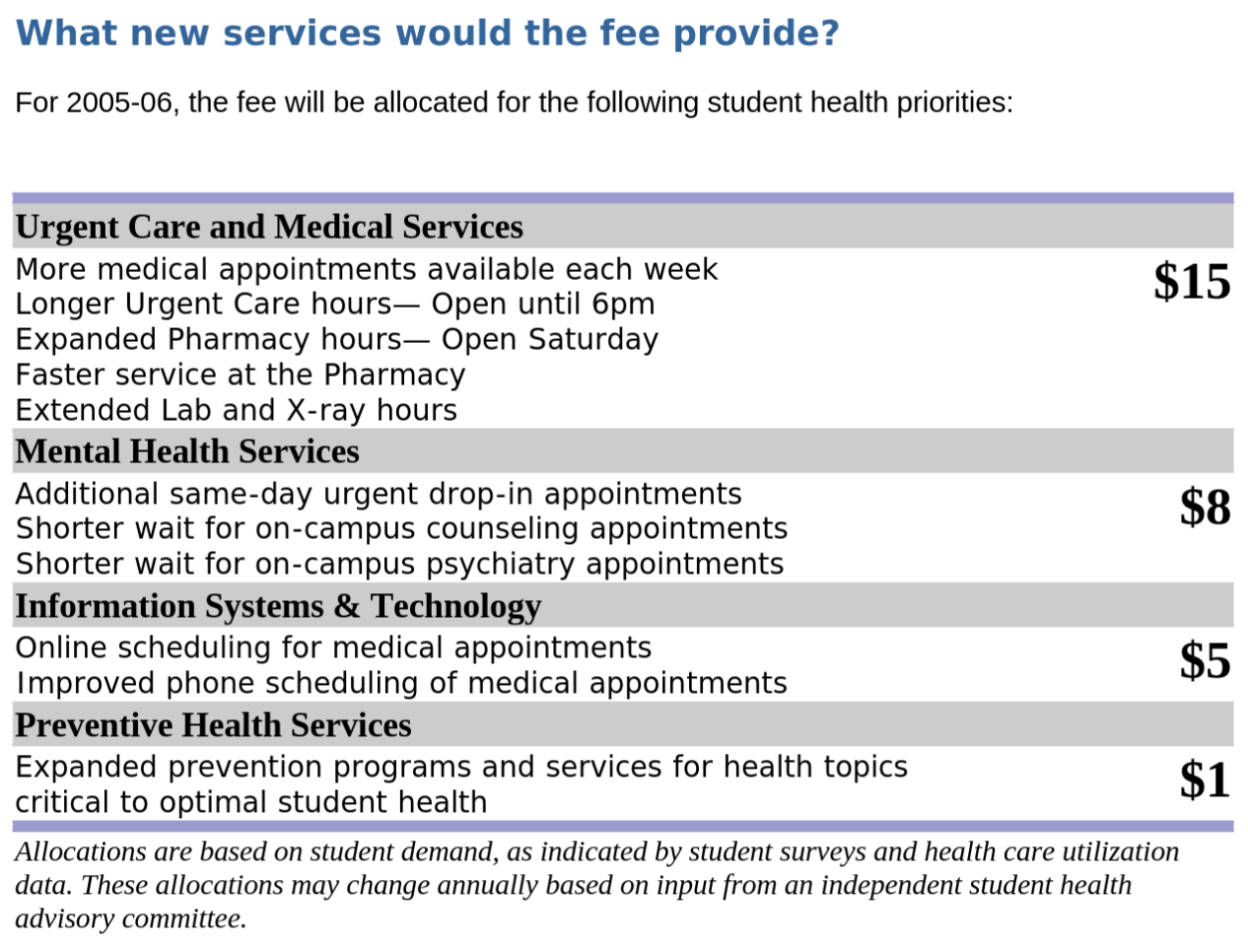
Breakdown of the Health Fee when it was first implemented
Many of these programs receive funding from HFAB to this day; however, the referendum emphasizes that health fee allocations should shift based on student demand. Services that might have been crucial for students five years ago may be less so now, while the need for a different program rapidly increased. The fee level may also need to be increased, or decreased, to match the needs of the current students who pay it.
Source: Berkeley Student Affairs: Health Fee Final Ballot 2005
The Health Fee Advisory Board
To ensure these annual changes get made, the referendum established the Health Fee Advisory Board. HFAB is an oversight committee which works to ensure that the Health Fee dollars are spent effectively at the Tang Center. We meet in the Fall to set priorities for Health Fee spending and recommend fee levels for the upcoming academic year. Recently, HFAB members have fought for initiatives to improve mental health support for BIPOC students and hired additional nurse practitioners, medical assistants, and counselors to ensure students receive the services they need.
Current Health Fee Funded Services
- Primary Care
- Urgent Care + Lab, Radiology and Pharmacy to align with extended hours
- Mental Health Services
- Counseling and Psychological Services
- Psychiatry
- Social Services
- Preventative Services
- Health Promotion
- Ease of Use
- Information technology (e.g., eTang patient portal)
- Appointment making
Keep in mind that the Campus Health Care Fee is intended to “supplement but not supplant” the other sources of income for UHS (tuition, SHIP premiums, etc). Our objective is to keep the fee level as low as possible while still meeting student health needs.
Membership
The voting members of the Health Fee Advisory Board are student representatives from the following groups:
- ASUC (2-3 Members)
- Graduate Assembly (GA) (2-3 Members)
- Committee on Student Fees (CSF) (2-3 Members)
- Student Health Advisory Committee (SHAC) (1-2 Members)
- At large members from the Berkeley student community
HFAB also welcomes any UC Berkeley student who would like to represent student interests at the Tang Center! Contact hfab@berkeley.edu to get involved.
HFAB also has two University Health Services (UHS) staff that help the committee operate.
| Name | Position | |
|---|---|---|
| Bené Gatzert | UHS, Chief Strategy Officer | bene@berkeley.edu |
| Cory Vu | UHS, Associate Vice Chancellor | coryvu@berkeley.edu |
Two students are also selected from the board each year to serve as co-chairs of the committee. They work with Bené to handle the logistics and planning necessary for HFAB to run smoothly.
| Name | |
|---|---|
| Stefania Lord | sllord615@berkeley.edu |
| Jaysa Garcia | jaysagarcia@berkeley.edu |
If you have questions or concerns regarding HFAB and the Health Fee, reach out to hfab@berkeley.edu and one of these members will get back to you.
Responsibilities
The two primary purposes of HFAB are outlined in the fee referendum:
- Recommend changes in the allocation of fee revenues to meet the evolving health needs of Berkeley students
- Advise on adjustments to the fee level
HFAB members go out of their way to talk to other students about what services they utilize or want to see from the Tang Center. Since the decisions HFAB makes affect the entire campus population, getting additional input from the Berkeley community is crucial to ensuring that HFAB represents their interests.
In order to make informed decisions, HFAB interviews staff from different units of the Tang Center each week in the Fall. These meetings give the board an idea of how current HFAB allocations are being spent, the success of individual programs, and what projects might be appropriate for the Health Fee to fund in the future.
Fee Recommendations
At the end of the Fall semester, HFAB members write a recommendation to the Associate Vice Chancellor of Health and Well-being (AVC) on the Health Fee level for the upcoming academic year. It addresses any concerns the committee may have with Tang Center services, and recommends UHS projects for the coming year. Historically, the AVC always follows HFAB's fee level recommendation.
Fee Level Cap
The health fee increase cannot exceed healthcare inflation rates for physician and clinical services published by the U.S. Bureau of Labor Statistics for that year.
All past HFAB recommendations and reports are available at uhs.berkeley.edu/hfab.